

The Next Kodak Is Not A Technology Company
Why Governance — Not AI Adoption — Will Decide the Next Generation of Enterprise Winners
Abstract
Most companies believe there is an "AI Race" underway — companies competing to deploy artificial intelligence faster. There isn't.
The difference across all types of industry will not be about who has deployed the most AI agents, co-pilots, or automated process platforms. The difference will be whether organizations have sufficient governance of autonomous decision-making to move forward responsibly and at speed.
The next major wave of enterprise transformation will be driven by companies that rapidly design new organizational models and operating paradigms around decision rights, accountability, and digital trust — to manage a future in which enterprise systems are making decisions rather than supporting them.
The Business Life Cycle Is a Law, Not a Theory
Every business has a life cycle. All organizations are born, grow, reach maturity, and ultimately decline unless they can adapt. Most often it comes down to whether there is organizational will — along with the governance structure to support that will — to make strategic decisions when required.
The numbers are clear. Since 1955, nearly 90% of the original Fortune 500 Companies have gone out of business or been acquired. Since 1958, the average tenure of a company on the S&P 500 dropped from 61 years to under 18.
These are not statistics about bad fortune. They are statistics about a pattern of governance failures — repeatedly failing to modify leadership frameworks before changes in technology made such a change necessary. In each instance, disruptions were apparent for years prior to becoming destructive. Businesses do not fail because they lack knowledge about future disruptive events. They fail because existing organizational and governance systems are built around protecting yesterday's economics rather than enabling tomorrow's.
Businesses generally do not lose because of an unexpected technological revolution. They lose because their corporate governance systems continue to operate using yesterday's economic principles. The most significant threat facing businesses now is not technological revolution — but inertia in corporate governance.
The Evidence Is Written in the Wreckage
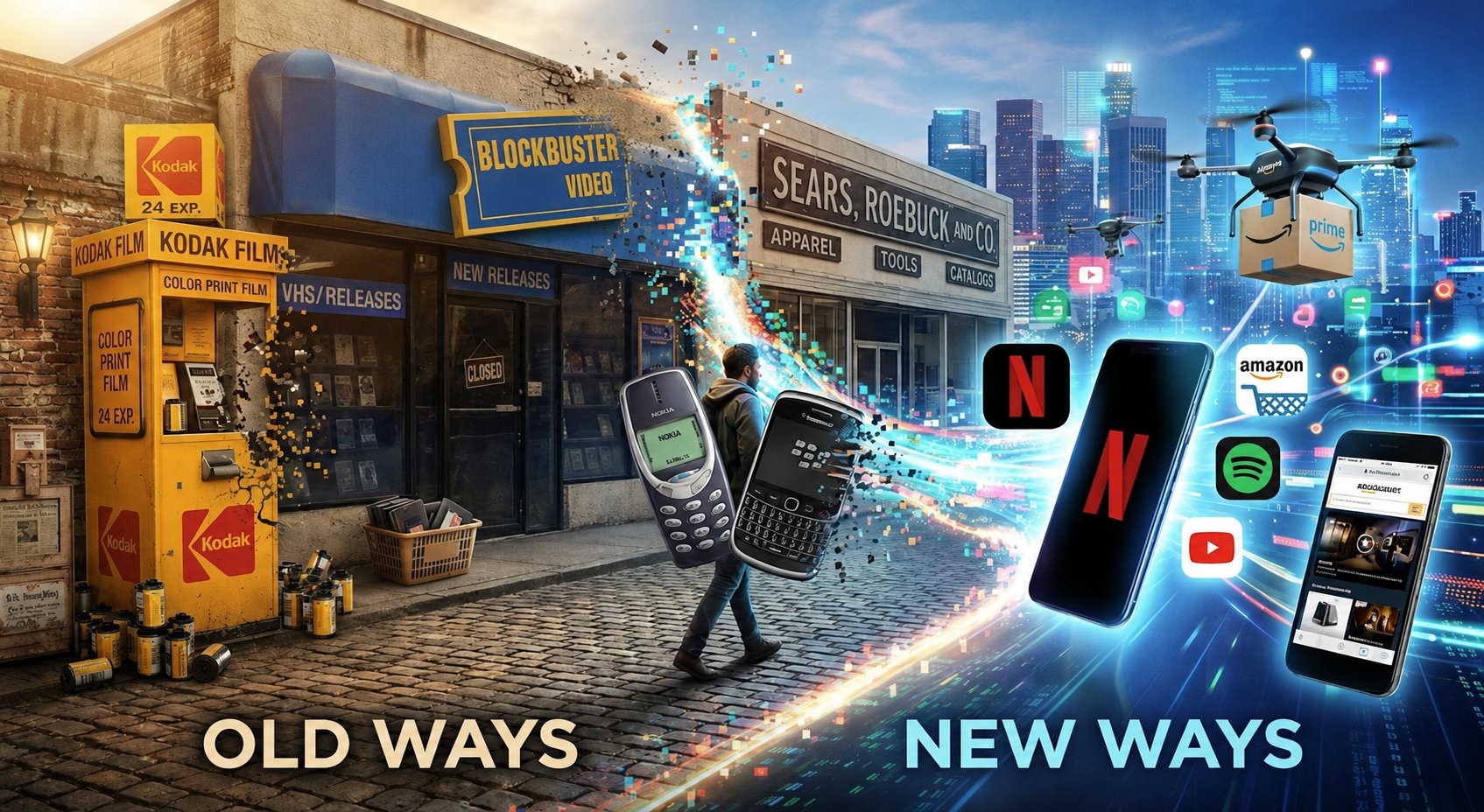
These five examples share a common element: all were subject to the same form of technological disruption now occurring across nearly every sector simultaneously. All five were clearly identifiable. There were no surprises. What varied was how well organizations were prepared to respond using their existing governance models.
| Company | Peak Position | Disruption Signal | Governance Failure | Outcome |
|---|---|---|---|---|
| Kodak | ~90% US film market; $30B market cap (1997) | Invented the digital camera internally in 1975 | Governance optimized to protect film revenue — not enable digital | Bankruptcy Jan 2012; Instagram acquired for $1B the same month |
| Blockbuster | $6B revenue; 9,000+ stores; 84,000 employees (2004) | Netflix offered partnership in 2000 for $50M | Governance built to maximize late fees — not stress-test the model | Bankruptcy Sept 2010; Netflix market cap now exceeds $250B |
| Nokia | ~40% global mobile market share (2008) | Engineers warned leadership of smartphone threat pre-iPhone | Culture prevented escalation; warnings never reached decision-makers | Microsoft acquired phone unit for $7.2B; wrote off acquisition in 15 months |
| BlackBerry | ~50% US smartphone market (2008–09) | iPhone launched 2007 with full market visibility | Leadership dismissed the threat — no governance mechanism to challenge it | Market share fell to under 1% by 2016 |
| Sears | $50B+ revenue; 3,500+ stores; 355,000 employees (1990s) | Owned early internet service Prodigy in the 1980s | Short-term financial engineering; incentives rewarded quarters not decades | Bankruptcy Oct 2018 |
Nokia's example is particularly instructive. Employees not only knew about the impending smartphone threat — they warned leadership. But corporate culture discouraged reporting negative information upward. Nokia's former CEO, when asked what went so badly wrong, responded: "I don't think we did anything wrong — but somehow we lost." That statement captures the most dangerous governance failure of all: when an organization loses the capacity to recognize a problem as it develops into something that cannot be changed.
Organizations do not survive by avoiding bad decisions. They endure by making the right decisions at the correct time — and that is a function of governance capability, not technology capability.
The Counter-Example: Enterprises That Governed Change
IBM's transformation from equipment manufacturer to global consulting and cloud-services leader required nearly three decades of sustained governance commitment. Netflix transformed from DVD mail delivery to streaming media within twenty years. Microsoft grew from under $350B in market capitalization in 2014 to over $3 trillion in 2024 after Satya Nadella restructured corporate governance around cloud-computing and AI collaboration.
All of these transformations succeeded because organizations established governance structures that provided both permission and pressure at every level to create proactive change — rather than reactive adjustments after disruption had already occurred.
The AI Disruption Is Different — And It Is Already Here
The AI transition represents the most significant governance challenge of the era — and it differs fundamentally from prior technology transitions. Cloud migrations, analytics modernization, and workflow automation primarily affected how companies process data. The AI transition affects who — and what — participates in decision-making. That distinction changes nearly everything about what governance and leadership must become.
From Systems of Record to Systems of Action
ERP and operational platforms have served as systems of record for over 30 years. Human beings interpreted system outputs, made decisions, and assumed full responsibility for those decisions. In emerging enterprise architectures, AI monitors conditions continuously, evaluates options at machine speed, and increasingly performs automated action. Examples include automated replenishment, dynamic supply chain allocation, and continuous financial risk assessment.
The new role of enterprise leadership is to provide intent to AI systems, establish policy boundaries on what AI may execute, and accept accountability for the outcomes AI systems generate.
| Previous Generation Enterprise | Agentic Enterprise Era |
|---|---|
| Systems of record & workflow orchestration | Systems of action & autonomous execution |
| Humans interpret data & approve decisions | AI evaluates trade-offs & triggers actions autonomously |
| Humans carry full operational accountability | Humans govern intent, policy, escalation & accountability |
| Planning identifies options — humans choose | Orchestration governs execution across changing conditions |
| Competitive advantage: scale, cost, infrastructure | Competitive advantage: governed decision velocity |
SAP, Oracle, Microsoft, Salesforce, and ServiceNow have embedded autonomous execution capabilities directly into their enterprise platforms. These are not indications of when an AI transition might occur — they are evidence that an AI transition is already underway.
The question is no longer: "How should we use AI?" The real question is: How will we govern an enterprise where machines increasingly participate in operational, financial, and strategic decisions?
Why Most AI Strategies Will Fail
The irony is stark. Most companies are intensely focused on the speed of AI adoption — investing in tools, creating pilot programs, appointing Chief AI Officers — while the governance structures needed to support and sustain those investments have not yet been built. Three distinct failure patterns are currently developing, each of which demands board-level attention.
Pursue AI tools aggressively without redesigning governance. Results in pilot proliferation, inconsistent controls, shadow AI usage, and escalating operational risk.
Treat governance as bureaucracy. Results in adoption paralysis, talent frustration, and competitive lag. Risk is reduced while market relevance is surrendered.
Assume AI governance belongs to IT or data teams. The most dangerous model — AI is becoming the operating model itself. Accountability must span Finance, SCM, HR, Legal, Operations, and the Board.
AI Governance is not an Information Technology framework. It is Enterprise Leadership Architecture. The organizations that build this architecture first will establish structural advantages that later movers — regardless of capital or resources — will find extremely difficult to replicate.
Governance Is the Engine of Innovation, Not Its Enemy
Effective governance is not an obstacle to transformation. It is the architecture upon which transformations are built, sustained, defended, and scaled. Kodak did have governance — unfortunately, its governance was designed to protect yesterday's model. The lesson is not that governance slows organizations down. Governance focused on yesterday's models will accelerate an organization's rate of decline.
Ungoverned AI introduces risk at a fundamentally different magnitude than any prior technology transition. Errors caused by poorly-governed AI do not occur as random, isolated mistakes. They proliferate at the speed of machines. An autonomous workflow operating on incorrect data could misposition inventory across a global network before any analyst detects the error. A replenishment agent without escalation limits could generate supplier exposure requiring months to reverse. An unregulated pricing or allocation AI could generate compliance violations faster than a governing body could respond.
The EU AI Act is in force now — not tomorrow. It classifies high-risk AI applications across employment, critical infrastructure, and financial services. Fines reach €30M per violation or 6% of global annual revenue, whichever is greater. Federal and state-level frameworks in the United States are developing along similar lines.
Governance is not merely defensive. Research from Accenture demonstrates that companies establishing strong AI governance structures achieve returns on AI investments 3.5× higher than those without such structures — not because they deploy less AI, but because they deploy it more effectively. Strong AI governance reduces employee anxiety around AI adoption, attracts skilled talent, builds customer confidence, and earns investor respect for ESG accountability.
Supply Chain: The First Enterprise Battleground
No business function is more directly exposed to autonomous decision-making — both in opportunity and risk — than the supply chain. Supply chains already operate as high-stakes decision networks. Demand variability, supplier risk, inventory positioning, logistical constraints, financial exposures, sustainability requirements, and geopolitical uncertainty interact constantly. Decisions throughout the supply network carry direct financial implications for working capital, service levels, margins, and revenue.
In the near future, AI agents will implement those decisions autonomously — without human approval at every step. It is not a question of whether AI has the capability; for many organizations in multiple settings, it already does. The question is whether organizations can design governance frameworks capable of managing that autonomy responsibly.
As AI agents begin implementing decisions rather than merely providing recommendations, the enterprise planning architecture requires a governance layer above the planning layer itself. Planning identifies possible solutions. Orchestration regulates implementation. Governance establishes accountability structures for autonomous execution at scale.
The Integrated Business Planning process must evolve accordingly. As explored in Series 006, IBP established as the enterprise-wide decision layer must now provide governance over AI agents making consequential decisions autonomously between governance cycles. The role of IBP shifts from aligning organizational plans to establishing intent, policy boundaries, and accountability structures under which autonomous execution occurs.
What Enterprise AI Governance Architecture Actually Requires
Most AI governance discussions end at policies, ethics statements, and technology controls. While all three matter — they are insufficient. What organizations require is a governance architecture: an integrated collection of design choices that function together as a system, not merely a compliance checklist. Five dimensions define that architecture.
| Governance Dimension | What It Requires | What Happens Without It |
|---|---|---|
| Strategic Guardrails | Define what AI systems may do independently, where they must escalate, and what policy boundaries apply per function. Owned at executive level and reviewed at each governance cycle. | Autonomous systems make decisions that are technically correct within their optimization logic but misaligned with enterprise intent. The gap widens until a material failure makes it visible. |
| Trusted Decision Data | Data lineage, quality standards, access governance, and integrity audit trails embedded as enterprise risk controls — not managed as IT back-office tasks. Directly extends the Digital Trust Foundation from Series 003. | AI on poor data does not produce poor recommendations. It produces confident, rapidly-executed, hard-to-reverse poor decisions at scale. |
| Explainability & Auditability | Every consequential AI decision must be reconstructable — what data drove it, what parameters governed it, who is accountable. Built into the system by design, not retrieved after an incident. | Regulatory exposure, customer trust erosion, and board-level accountability failures. Enterprises that cannot explain autonomous decisions will face consequences that compound. |
| Decision Rights Architecture | Named human owners, escalation paths, and override mechanisms for every material autonomous decision domain — defined before autonomy scales, across Finance, Supply Chain, HR, Legal, and Operations. | Accountability dissolves at exactly the moment it is most needed — when an AI error amplifies across the enterprise at machine speed. Crisis management replaces governance design. |
| Resilient Orchestration | A governance layer that coordinates AI-driven decisions across functions — ensuring supply allocation, commercial commitments, working capital constraints, and sustainability requirements align dynamically. IBP redesigned as governance mechanism, not reconciliation meeting. | Local optimization at the cost of enterprise coherence. Each function's AI performs well in isolation while the enterprise as a system underperforms — or fails. |
The New Measure of Enterprise Maturity
Traditional measures of enterprise maturity — ERP standardization, process harmonization, automation levels, data visibility, and cost efficiency — defined the prior decade. The next ten years will be evaluated on five capabilities that will determine access to funding, talent, and competitive positioning.
| # | Capability | Why It Will Define Market Position |
|---|---|---|
| 01 | Decision Transparency | Regulators, boards, customers, and employees increasingly require enterprises to explain how autonomous decisions are made. Explainability is becoming a legal requirement and a trust standard simultaneously. |
| 02 | Enterprise Orchestration | Decisions must align dynamically across supply chain, finance, commercial, and operations in real time — not reconciled monthly after independent AI agents have already acted. |
| 03 | Digital Trust | Leaders must be able to verify the integrity of data, models, and execution logic. An enterprise that cannot trust its AI inputs cannot govern its AI outputs — and investors and partners are beginning to assess this directly. |
| 04 | Governance Velocity | Static governance frameworks become liabilities as AI capability advances. Organizations that build adaptive governance — designed to evolve — will outmaneuver those treating governance as a one-time policy exercise. |
| 05 | Human Accountability | Material financial and operational outcomes require named human ownership, even in autonomous environments. Organizations that design accountability explicitly into their AI systems will earn regulatory credibility, customer trust, and top talent. |
What Leaders Must Do Now
Boards and CEOs have a specific set of responsibilities going forward. Those organizations that succeed will act while governance gaps remain closeable — before operational failures make governance redesign reactive rather than strategic.
| # | Priority Action | What This Means in Practice |
|---|---|---|
| 01 | Elevate AI Governance to Board-Level Responsibility | Boards require direct visibility into autonomous decision exposure, data trust maturity, accountability structures, and regulatory risk. This is not an IT agenda item — it is a fiduciary responsibility. The boards of future Kodaks will be asked why they did not treat it as one. |
| 02 | Redesign Decision Rights Before Scaling Autonomy | Most organizations are automating workflows before redefining accountability. That sequence is backwards. Named ownership across Finance, Supply Chain, HR, Legal, and Operations must be defined before autonomous execution scales — not reconstructed after an AI error amplifies. |
| 03 | Evolve IBP Toward Enterprise Orchestration | IBP must become a dynamic governance structure — receiving AI-generated outputs with financial implications already quantified, so that human judgment governs strategic direction rather than reconciling functional plans that AI agents have already acted on. |
| 04 | Build Digital Trust as an Enterprise Capability | Trusted data, explainable models, transparent workflows, and auditable execution are foundational risk controls for an enterprise where AI makes operational decisions — not IT infrastructure managed below the leadership line of sight. |
| 05 | Prepare Leadership for the Agentic Enterprise | Future leaders must govern autonomous systems, human-machine collaboration, and continuous operational adaptation. Planners become orchestrators. Analysts become exception strategists. Operators become AI supervisors. This redesign is a governance responsibility — not a byproduct to manage after deployment. |
Closing Insight
Kodak didn't fail because it didn't anticipate digital photography. Nokia didn't lose its engineering edge. Blockbuster didn't fail because of streaming media. They lost their markets because the systems of leadership were structured to protect the status quo — and the resulting governance inertia became stronger than any awareness of new technology.
The AI era offers the same test for all enterprises at scale, with higher stakes and far shorter timelines. Systems of AI operating outside the scope of governance don't merely underperform. They magnify failure. Autonomous decision-making without accountable structures doesn't just create risk — it creates exponentially larger risk, across the entire enterprise, as fast as machines can execute.
The next Kodak won't go bankrupt because it didn't see the opportunity for artificial intelligence. It will fail because it saw the potential for artificial intelligence — and chose to govern it inadequately.
Series Connection: Trinity Insights
| # | Trinity Insight | Topic / Framework |
|---|---|---|
| 001 | The Trinity Pyramid™ | Introduction to the five-layer Trinity Pyramid — from Digital Trust to Strategic Optimization. Read → |
| 002 | From Planning to Orchestration | The ADAPTIVE™ Model — eight interconnected layers for a new planning operating model. Read → |
| 003 | Digital Trust Foundation | The TRUST™ Framework — governed data, secure integration, and AI-readiness at Layer 1. Read → |
| 004 | Workflow Automation Imperative | DARE™ Framework — AI-enabled supply chain transformation. Read → |
| 005 | Human-Led AI Planning | The GUIDE™ Framework — Trinity's operating model for Human-Led AI Planning. Read → |
| 006 | Enterprise Decision Orchestration | The ORCHEST™ Framework — cross-functional decision alignment and the Decision Cockpit. Read → |
| 007 | Strategic Optimization Architecture | The APEX™ Framework — enterprise outcome optimization above orchestration. Read → |
| 008 | The Next Kodak Is Not A Technology Company | Why Governance — Not AI Adoption — Will Decide the Next Generation of Enterprise Winners. Current paper. |
| 009 | Leadership Lessons for the AI Era | What Satya Nadella Teaches Supply Chain and Enterprise Leaders About Governing AI Without Ego. Read → |
Work With Trinity Solutions LLC
Trinity Solutions LLC helps enterprise leaders design governance architectures for the agentic enterprise — from AI decision rights and accountability structures to IBP evolution and Digital Trust capability. Every engagement begins with human judgment and ends with enterprise resilience.
trinitysolutionsglobal.com | Human-Led. AI-Assisted. Wisdom-Driven.
References
- BCG — Supply Chain Planning 2026: Why AI Alone Isn't Enough. bcg.com
- Gartner — AI in Enterprise Operations 2025; Autonomous AI Agents and Planning Maturity Research. gartner.com
- McKinsey & Company — The State of AI 2024; AI and Disruption in Enterprise Operations. mckinsey.com
- IDC — Global AI Market Forecast 2024–2027. idc.com
- Accenture — Responsible AI: Governance Maturity and Investment Return Research. accenture.com
- World Economic Forum — Future of Jobs Report 2023. weforum.org
- Deloitte — The Resilient Supply Chain 2024–2025. deloitte.com
- European Union — EU AI Act, Regulation on Artificial Intelligence 2024. eur-lex.europa.eu
- ASCM — Top 10 Supply Chain Trends 2026; IBP Process Standards. ascm.org
- Harvard Business Review — AI Governance and the Board-Level Accountability Gap, 2024. hbr.org
- Trinity Solutions Global — Trinity Insights Series 001–007. trinitysolutionsglobal.com